Airborne Payload & Process Integration: Aligning Sensors, Systems, and Strategy
Updated: Oct 21
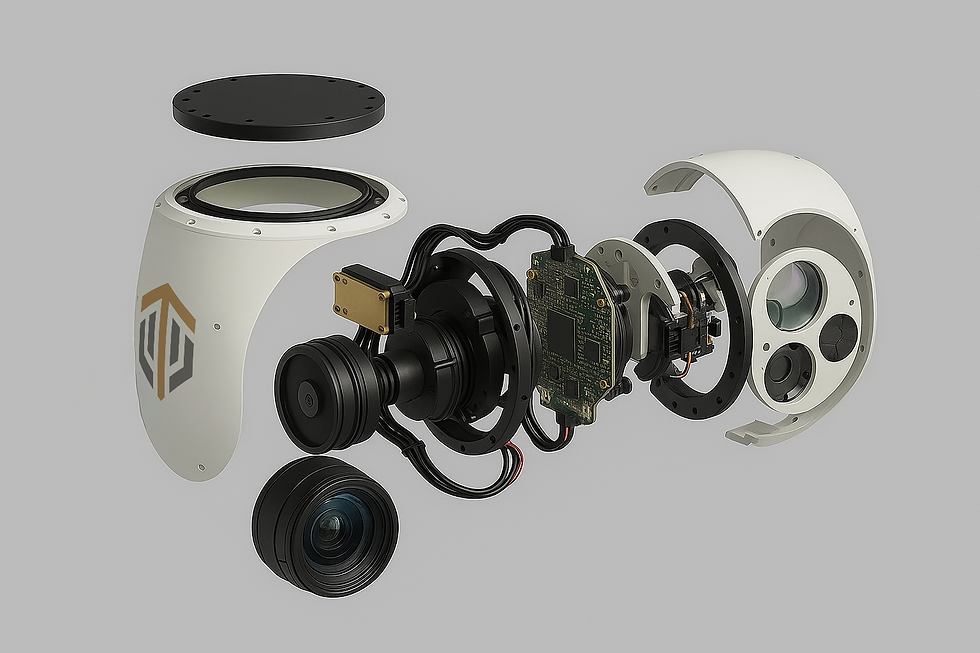
As Airborne Remote Sensing programs mature, the payload has evolved far beyond a mounted sensor — it’s now the nucleus of the operation. It defines not only what data is captured, but how that data moves, interacts, and drives decision-making throughout an organization.
Tactien’s Airborne Payload & Process Integration service was built to help utilities and infrastructure operators navigate this complexity — unifying the aircraft, the sensors, and the data architecture into one defensible system that performs predictably and scales responsibly.
Because at scale, performance isn’t just about flight — it’s about flow.
The Challenge: Disconnected Systems, Disjointed Outcomes
For many operators, payloads are still treated as accessories rather than integrated subsystems. Different vendors, different data formats, and disconnected delivery pipelines often lead to inefficiency, inconsistent data, and friction across operations.
Even advanced aircraft can underperform when the payload, the data flow, and the mission requirements aren’t aligned.
Redundant or incompatible workflows
Bandwidth bottlenecks during flight
Misaligned power or weight configurations
Fragmented analytics and reporting chains
Tactien’s approach solves these problems by addressing the payload as its own engineered system — one that harmonizes hardware, data, and process into a single operational rhythm.
The Tactien Approach: Architecting the Payload Ecosystem
Our process begins by understanding your mission, not your equipment list. We reverse-engineer from the desired data output and operational tempo to design a payload and data framework that ensures performance, reliability, and scalability.
Define Requirements
We start with the customer’s CONOPS — the mission profile, aircraft parameters, and SWaP limitations — translating them into payload requirements that inform every downstream decision.
Design Data Architecture
We model the data flow — from air to ground to enterprise — establishing the backbone for how information moves, stores, and integrates with existing systems.
Source and Validate
We identify and evaluate vendors for sensors, processors, and communications systems through a vendor-neutral process focused purely on performance and interoperability.
Integrate and Test
We oversee the installation and calibration of components — both onboard and on the ground — then validate through structured field trials, measuring data integrity, latency, and system resilience.
Deliver and Transition
The engagement concludes with a comprehensive Payload Integration Report, training, and knowledge transfer so your team can sustain and scale the system independently.
Why Integration Matters
Integration is what turns data collection into data intelligence. Without it, even the most expensive payloads generate isolated insights that never connect to the larger mission.
A well-integrated payload ecosystem enables:
Faster decision-making through synchronized data workflows
Higher data fidelity with reduced transfer losses
Simplified operations across multiple aircraft and sensors
Scalable architectures ready for BVLOS and advanced missions
The difference is measurable — and repeatable.
Vendor Neutral. Mission Driven.
Tactien is not a reseller or hardware provider. Our independence allows us to source objectively, test honestly, and design systems that serve the mission — not the manufacturer.
Our customers gain confidence knowing that every integration is justified by data, validated in the field, and built for long-term ROI.
Beyond Integration — Toward Intelligence
Payload integration isn’t just a technical exercise. It’s a strategic one. When designed correctly, your data flow architecture becomes a force multiplier — reducing operational friction and enabling smarter, faster decisions.
For modern UAS programs, integration is no longer optional. It’s the foundation of sustainable, scalable, and safe operations.
📘 Explore this week’s Value Vault Use Case: Airborne Payload & Process Integration
#UAS #UtilityInnovation #DataIntegration #PayloadArchitecture #Aviation #DroneOperations #StrategicAdvisory #Infrastructure #BVLOS #Tactien


